
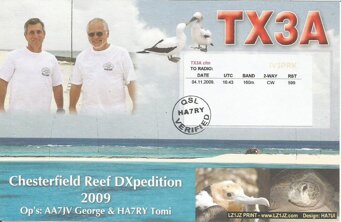
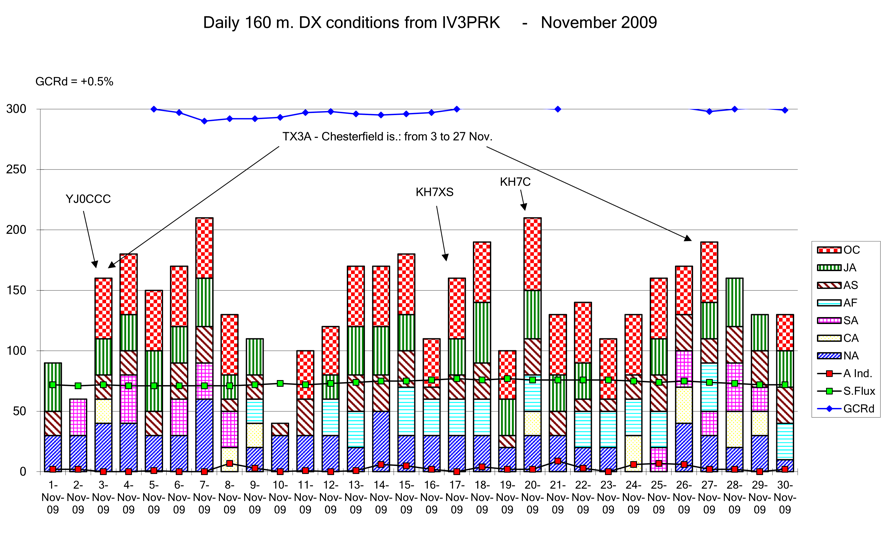
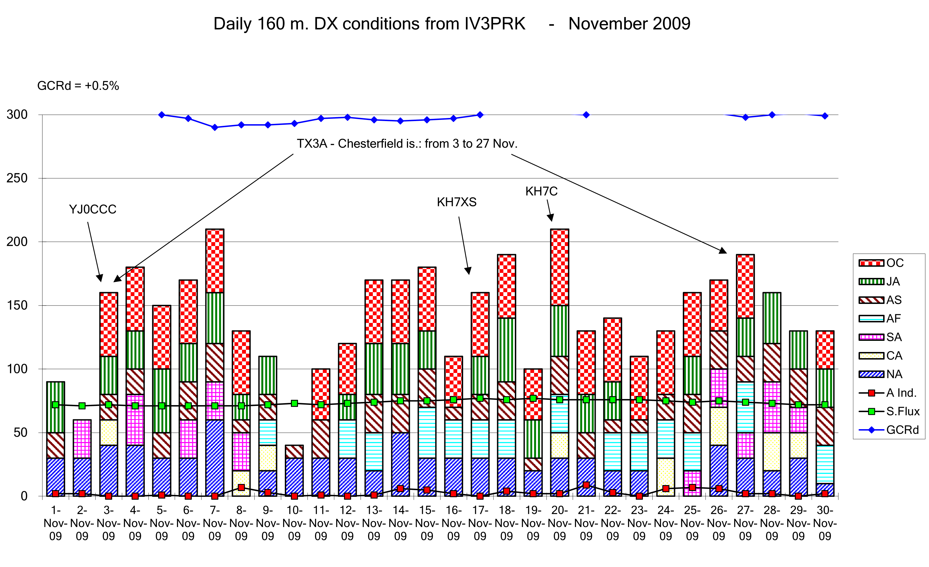
The month of November has also been similar to October, with solar flux at its minimum level and the geomagnetic field extremely quiet. The entire month was marked by the great DXpedition on Chesterfield Island by George AA7JV and Tomi HA7RY, as highlighted below. The exceptional conditions have already been evaluated on the “Propagation page” with an analysis of the Hawaii-to-Italy North Pole path. No further analysis has been performed here, as the entire TX3A story is still available on their site.
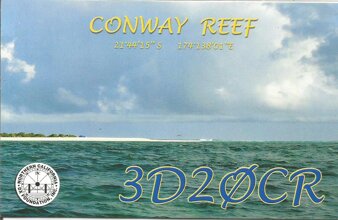
In October 2009 we had so many DXpeditions in rare islands which gave a lot of new ones to everybody: FT5GA and TO7RJ in Africa, ZY0T in South America, but specially 3D2KJ, 3D20CR, H44MY, TX5SPA, YJ0CCC and the big one from Midway, K4M. Most, but not all, European Topbanders, with good receiving antennas, successfully worked these stations on such long and tough paths.
I managed to work four of them (TX5SPA and YJ0CCC before sunrise, and 3D2KJ and 3D20CR after sunset), but I never heard a whisper from H44MY or K4M. The most impressive and heroic effort came from my friend Yasek, SP5DRH, who called - alone - on 160 meters every day from Oct. 3 to 28. After the DXpedition, he sent me his comments and pictures, with the complete log for my analysis.
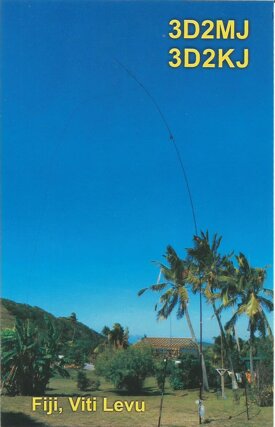
3D2KJ Fiji is. DXpedition by SP5DRH - October 2009 =====>>
by Pierluigi Mansutti IV3PRK - all rights reserved
IV3PRK Pierluigi “Luis” Mansutti
160 Meters: DXing on the Edge
Pacific DXpeditions stories and analysis.
When antennas, listening and… luck were needed!
On this page, I will provide downloadable PDF files of past analyses I conducted on some DXpeditions in the challenging Pacific area, using logs kindly shared by the operators or, later, by examining the “Club Log” data. To map the areas in Europe where a 160-meter contact was possible, I assigned each logged station its presumed Grid Locator based on information from QRZ.com. Unfortunately, as we all know, a large portion of DX QSOs are now made through remote SDR, making it impossible to verify the actual location, so continuing this type of analysis no longer makes sense.
Anyway, the islands remain, and propagation conditions are likely to return with the eleven-year solar cycle. For dedicated Topband enthusiasts, especially the younger ones, it could be intriguing to delve into what happened two cycles ago. Additionally, I suggest younger DXers explore how DX chasing was handled thirty years ago, before online logs and cluster spots became a thing!
The new era of the Bavarian Contest Club DXpeditions.
Until about thirty years ago, it was uncommon, if not impossible, to hear a DXpedition in the Pacific working Europe on 160 meters. These expeditions often overlooked our continent, mainly because they lacked proper low-band antennas. This changed thanks to a few dedicated members of the Bavarian Contest Club and their innovative Titanex vertical antenna. Designed for portability, the special V80E (E for Expedition) version stood 20.5 meters tall but could be packed into 2-meter-long sections weighing just 6 kg.
Easy to set up anywhere with a couple of tuned elevated radials, this efficient antenna delivered a strong signal - 500 watts - worldwide, on both 80 amd 160 meters band.
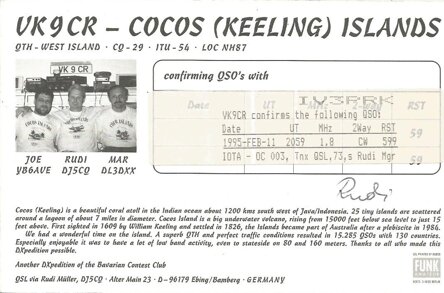
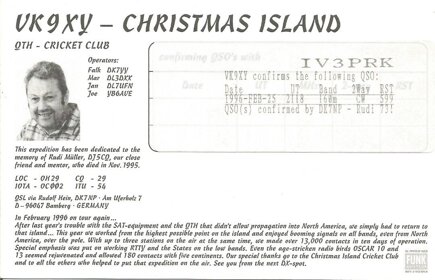
Their first notable DXpedition was VK9CR in February 1995, conducted by Rudi DJ5CQ, Dietmar DL3DXX, and Joerg YB6AVE (formerly DL8WPX). In November, Rudi DJ5CQ, the leader of the group, passed away, and the following February 1996, his companions, along with Falk DK7YY and Jan DL7UFN, repeated the DXpedition to the same locations using the same callsigns. VK9CR - Cocos Keeling - from February 14 to 23, achieved 559 QSOs on 160 m. (44 with North America and 327 with Europe); VK9XY - Christmas Is. - from February 5 to 12, and then again on Feb. 24 and 25, for a total of 353 QSOs on 160 m. (22 with NA and 173 with Europe under more challenging conditions).

February 1997: P29VXX - DXpedition to Papua New Guinea.
In February 1997, after wrapping up a highly successful low-band operation from Bangladesh as S21XX, the German team of Falk (DK7YY), Jan (DL7UFN), Joerg (YB1AQS), and Dietmar (DL3DXX) flew straight to Port Moresby, New Guinea. From there, equipped with the usual Titanex V80E package, they continued to Misima Island for their first DXpedition on the Pacific side. Misima Island is actually one of the New Guinea's farthest points to Europe, but the place had all the qualities of a good DX location. In fact, the distance of P29VXX to my QTH was 14,465 km.


They were active from February 20 to March 3, and I only heard them on the 25th, when I made contact. Later, I was surprised to find out I was the only station from Italy in the 160 m log, and even more so when I realized I had been the westernmost station in Europe worked by P29VXX. Check out my analysis here:
I reached out to Professor R. Brown, NM7M, the most recognized expert on low band propagation, for explanations. After personally reviewing the P29VXX logs, Bob sent me a nine-page article, complete with nine figures, on the topic.
I had asked him about ducting conditions on that occasion, but Prof. Brown ruled it out in my case. The title of his article, “Reflections on 160 Meters: The Joys of Salt Water and the Sorrow of Ground,” is something I scanned and uploaded to this page.
That's a draft of an article set to be published in “Quarterly Communications,” but Bob gave me permission to share it with anyone interested. I selected some of the simpler sections and incorporated them into my own P29VXX analysis.
February 1998: ZL7DK - DXpedition to the antipodal Chatham Island.
After their double DXpedition to Bangladesh and Papua New Guinea in February 1997, the German team grew from four to six members. A year later, they set off for Chatham Island, located 19,200 km away on the opposite side of the world, nearly antipodal. Managing a 19,000 km contact on 160 meters was incredibly challenging. Someone mentioned that in parts of Europe, it would have been impossible. However, I had so much faith in these operators that I booked ten days of holidays.
They made over 600 QSO's on 160 meters, 120 of which with Europe. Two of us made it from Italy, as the westernmost in Europe but, while Fausto I4EAT worked them on February 26, I had to suffer and wait until Friday, March 6th, the last day of my holidays!
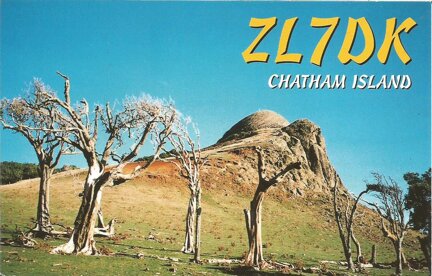
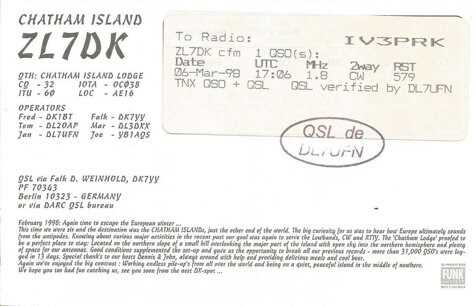
One of the operators, Joerg DL8WPX/YB1AQS, posted a beatiful report on Toband Reflector, together with the 120 European callsigns worked. I ordered them with their own grid locator and made out an analysis of the DXpedition on a seven pages PDF document downloadable here:
DXpeditions at maximum of Solar Cycle.
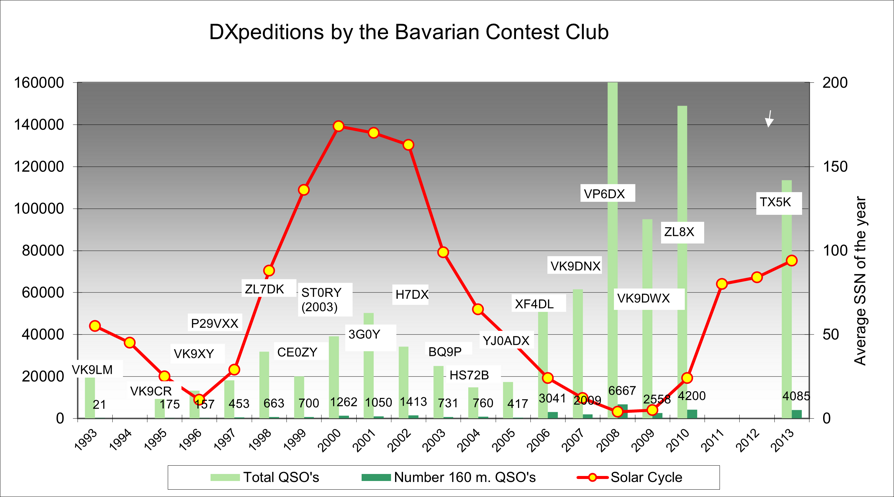
With increasing solar activity and geomagnetic disturbances, which usually hinder low-band propagation in high-latitude areas, Dietmar and friends moved away from the central and southern Pacific regions. They organized even larger DXpeditions in locations accessible to Europe via low-latitude paths, far from the dangerous auroral zones. Over the years, the expanded team (including guest operators of other nationalities) enhanced their skills and equipment, utilizing Beverages and separate Titanex verticals for 80 and 160 meters. They achieved 50,000 QSOs (3G0Y and XF4DL), with 3,000 of them on 160 meters from Revilla Gigedo in 2006.
April 2000: VP6BR - Pitcairn is. 160 m. operation by Jukka, OH2BR.
But on 160 meters unexpected things may always happen, even at Solar Maximum!
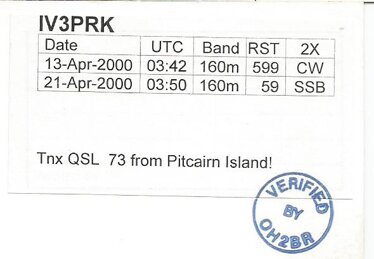
This was an unforgettable and delightful surprise from Jukka, OH2BR, who chose to celebrate his 40 years of ham radio from January to April 2000 on the most remote island on Earth. He stayed as a guest of Tom Christian, VP6TC, the most renowned of Pitcairn's 45 permanent inhabitants, all descendants of the Bounty mutineers. The full story, along with pictures and comments, is still available on this website.
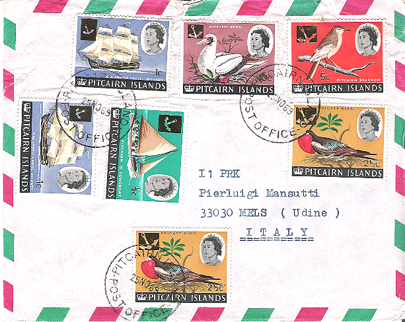
I will always remember the thrill of my first QSO with Pitcairn Island over thirty years before on 20 meters. Back then, Tom was VR6TC, and he sent me his QSL card in the cherished envelope shown here - stamped 1969 - thanking me for the “One” U.S. Dollar enclosed: «thanks for the 1$» he wrote «It sure helps with postage as costs do run high» - those were different times!
During his three months, operating from the maritime radio station at 270 m. on top of the island, Jukka made 56k QSOs on all bands and modes, with 642 on 160m. However, it wasn’t until after April 10 that he was heard in Europe on 160 meters. In just a few days, he made 177 QSOs - 25 of them on SSB - including a remarkable pipeline to Italy with 44 QSOs. I had no idea there were so many of us active on this band!
The analys of the European 160 m. log, withgraphs and Jukka's comments have been reported on this PDF file:

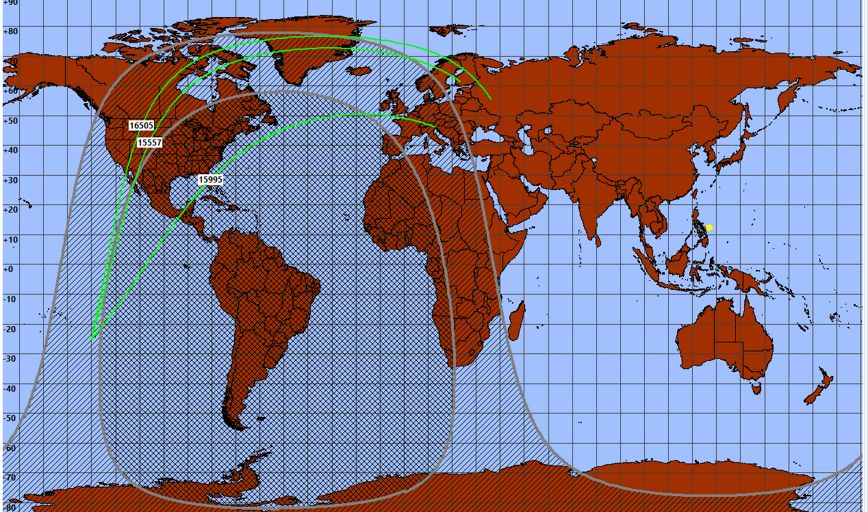
Despite the surprising success of European contacts on 160 m, Jukka was disappointed that he couldn’t manage to connect with his home country. He was heard once by OH1XX, but it wasn’t enough for a QSO. The issue was the high-latitude path to Northern and Eastern Europe, crossing the polar cap area - a challenge that’s nearly impossible during solar maximum.
February 2007: back to South Pacific on Norfolk Island - VK9DNX Dxpedition.
On February 2007, almost at the bottom of Cycle 23°, the Bavarian Contest Club reappeared with ts first big DXpedition fron South Pacific: VK9DNX. Eigth German operators and three stations, in 17 days (from Feb. 14 to March 2nd) made over sixty thousand QSO's reaching 2.000 on 160 meters: awesome! The focus on Europe ended up with 44% of the contacts, followed by Asia with 31% and North America with 22%.
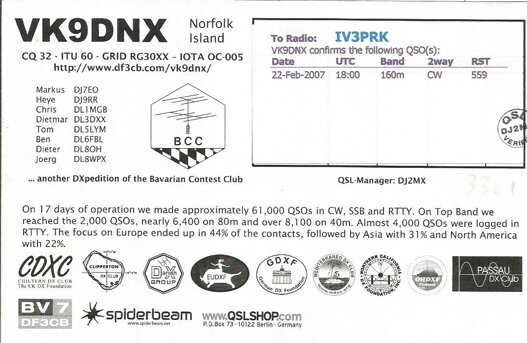
I worked them during the second week, and then followed their operations, which were peaking here every day at 18.00z, but I was'nt not too attracted by this DXpedition since I already had the 160m. QSL card of VK9NS, Jim Smith, the legendary resident of Norfolk Island with his wife Kirsti. Old Timers may remember him as the M.C. on the Pacific DX Net on 14.265 SSB back in the 1970's. (At that time is callsign was P29JS).
February 2008: VP6DX - the big international DXpedition to Ducie Island.
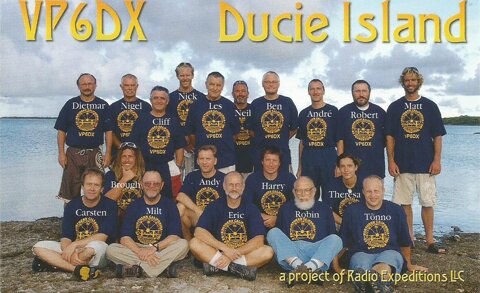
This was one of the most remarkable DXpeditions in the Pacific region, to a new DXCC country, Ducie Island, near Pitcairn. It was organized with the Northern California DX Foundation and other societies, and the support of numerous sponsors. In 16 days of operation, they logged 183,000 QSOs with nearly 40,000 unique calls. At the conclusion, they included a small booklet with the QSL card, containing all the details about the DXpedition. The team operated from two camps with members from six different nations.
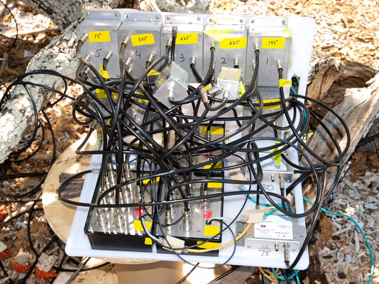
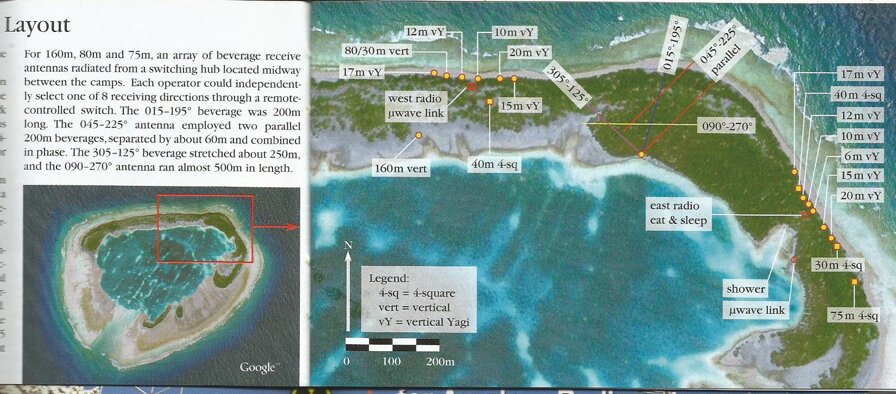
For 160 meters, they used a Titanex V160, 26 m. tall, along with eight Beverages, employing a sophisticated system designed by N5IA and WA6CDR (see pictures down here). This allowed also the "little pistols" worldwide to make contacts. In total, they achieved 6,615 QSOs on 160 meters (5,053 on CW and 1,562 on phone), with 13% from Europe, 71% from North America, and 14% from Asia.
Unfortunately, I can’t extract all those numbers from the logs into my Excel sheets for analysis… but it would be not very significant since everyone seems to have worked them!
October 2008: VK9DWX - Another big one to Willis Island.
In the year 2008, being at the minimum of solar cycle - with the best expected low-band conditions - and following their February VP6DX DXpedition, the Bavarian Contest Club planned for the month of October another major operation in the South Pacific, heading to Willis Island.
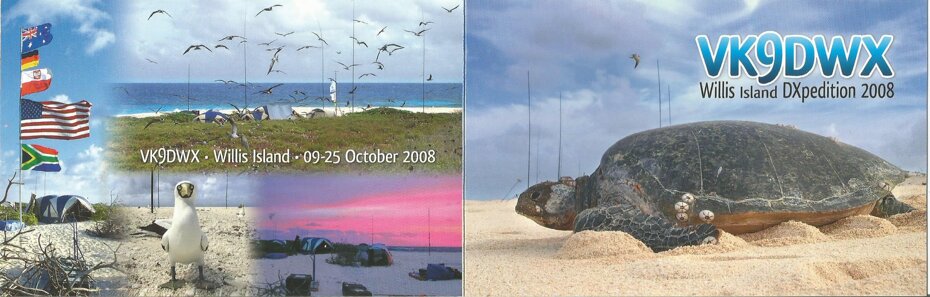
Willis Island lies a few hundred kilometers south of Misina Island, making its path to Europe similar to that of P29VXX but slightly longer (about 300 km).
A comparison with that operation was expected: as mentioned earlier, it was in February 1997 - just one cycle ago - with the same low and flat solar and geomagnetic numbers, differing only by the month, but the results of VK9DWX were outstanding!
While the P29VXX 160 m QSOs with Europe were only sixty, with myself and a couple of DLs being the westernmost stations reached, VK9DWX managed to work over one thousand Europeans on 160 m (40 in Italy and 150 in Germany), covering the entire continent, from Iceland and all the British Isles (over 30 G's in the log) down to Portugal.
From the entire 65k log sent me by Dietmar DL3DXX, I extracted all 2,500 160 m QSOs and organized the European entries with their grid squares in my spreadsheet for a detailed day-by-day analysis, presented with numerous graphs in this PDF file.
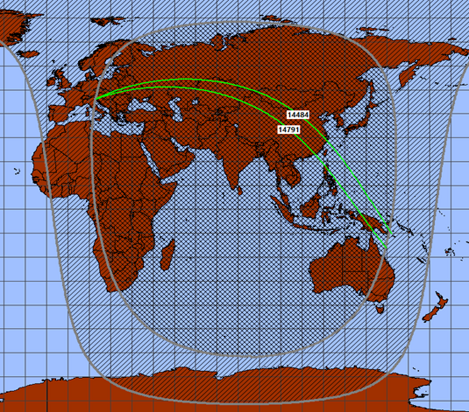
October 2009: 3D2KJ - DXpedition to Fiji is. by Jacek SP5DRH.
After enjoing two years of solar minimum, between the cycles 23 and 24, we came to what I’ve already called “The best 160 m month of my life”, October 2009. This monthly graph shows the daily band DX conditions in relation to Solar Flux and A Index - both of which remained flat and quiet throughout the period - and Galactic Cosmic Rays (though they’re not part of the picture here).
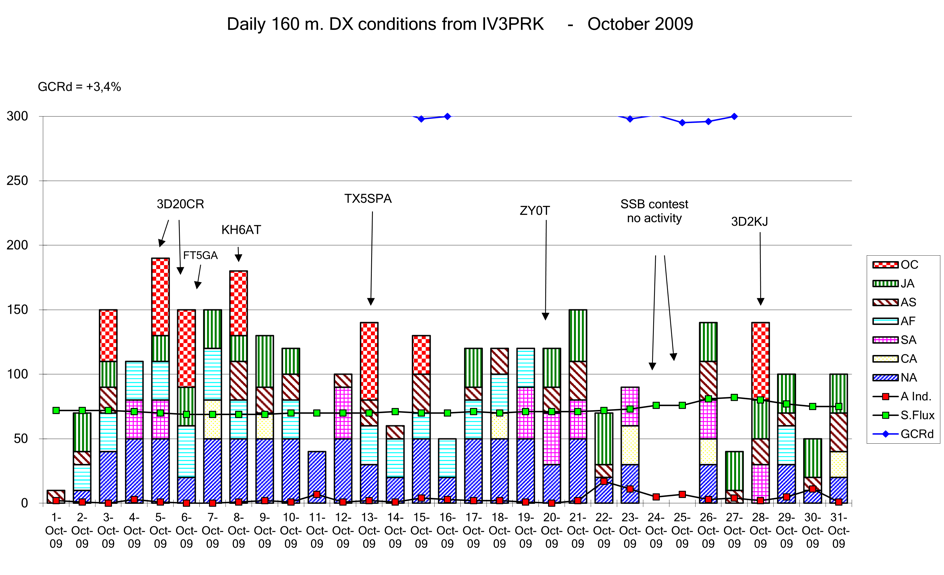
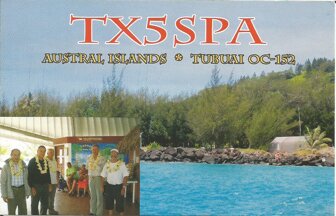
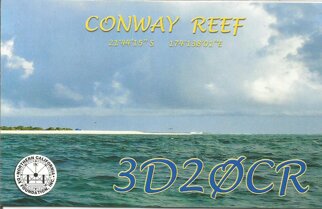
In October we had so many DXpeditions in rare islands which gave a lot of new ones to everybody: FT5GA and TO7RJ in Africa, ZY0T in South America, but specially 3D2KJ, 3D20CR, H44MY, TX5SPA, YJ0CCC and the big one from Midway, K4M. Most, but not all, European Topbanders, with good receiving antennas, successfully worked these stations on such long and tough paths. Unfortunately, despite carefully listening, I never heard a trace of K4M (Oct. 13 to 19) worked by all the I4AVG/I4EAT group from their super-station in the lowlands near Ravenna, congrats to them. Personally, after 20 years of 160 m. experience, I would also never believe it could be even possible to work Fiji is. without real good long Beverages or… some kind of miracle!
But on 160 meters anything unexpected sometimes may happen: you have to trust and be there luckily at the right time. I managed to work four of the six Pacific DXpeditions of the month: one (the Austral is.) in the morning - before sunrise, and three (Vanuatu, Conway Reef and Fiji is.) in the evening - just after sunset.
This last one has been the most challenging, made possible only through the dedication and perseverance of a single operator, my friend Jacek SP5DRH, who sent me his complete 160 m European log along with pictures and comments, included in my usual analysis. Click here:

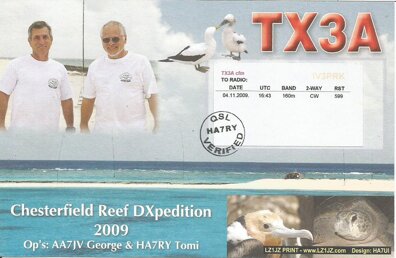
Also November turned out to be a fantastic month for Topbanders, with low and stable solar numbers and an absolutely quiet geomagnetic field. The highlight was the incredible DXpedition TX3A on Chesterfield Island, led by the well-known duo George AA7JV and Tomi HA7RY. During nearly a full month of operations, they logged 36,000 QSOs, including 3,400 on 160 meters. For full details of the DXpedition, check out their website.
The TX3A log is too large to analyze, as nearly everyone worked the DXpedition with such a strong signal coming in almost daily, as reflected in my monthly 160m graph.
November 2010: ZL8X Kermadec is. - another major German DXpedition.
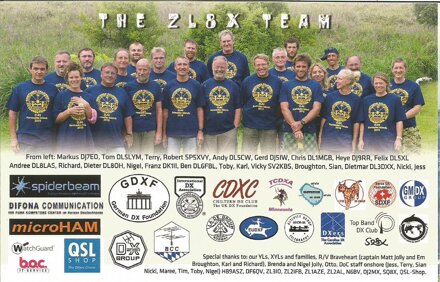
This has been, as usual, a great low-band operation by Dietmar DL3DXX and the well experienced German Team of about twenty operators. In 17 days they made 148.750 QSO’s , with 4.225 of them on 160 meters.
All the story, statistical data and pictures can be found on the dedicated website, containing info on all the many other DXpeditions of the new “Lagunaria DX Group” formed by all members of the Bavarian Contest Club.
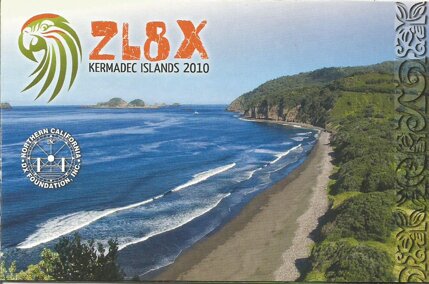
The path length to ZL8X, located on Raoul Island in the Kermadec Group, is 17,900 km at 31 degrees—a challenging distance from my QTH. During the first 10 days of operation, I didn’t hear a thing, while all of Europe, both north and south of me, was working them. Then, on November 29, ZL8X suddenly emerged from the noise for half an hour, and in the following days, they were peaking at 579 for extended periods—truly amazing! Could such steady ducting propagation conditions last for so long?
An even more incredible discovery from the ZL8X logs - thanks to Dietmar DL3DXX for sending me them - is the 105 QSOs with Europe via the LONG PATH, including four with northern Italy!
Overall, they achieved one thousand QSOs with Europe on 160 meters.
Check out this PDF file of my analysis with graphs and comments:
March 2011: T30RH - Western Kiribati by Jacek SP5DRH.
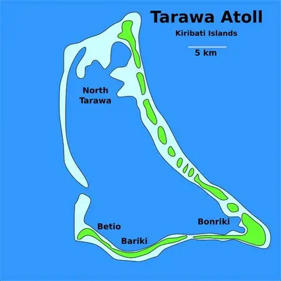
This was another Pacific DXpedition focused on 160 meters towards Europe by Jacek SP5DRH. The operation took place from March 1 to 17 on Tarawa Atoll, grid location RJ61NJ, at a distance of 14,400 km with a great circle bearing of 26 degrees through the aurora oval. The only opportunity for contact was during the common darkness period between our sunset at 17:10z and T30 sunrise at 18:30z, but I never heard a whisper. Jacek gave his best effort and managed to work with sixty Europeans, who benefited from spotlight propagation: in Italy not the usual I4/IK4's, but two almost unknown IT9's down in Sicily. Then, I received the T30RH 160-meter log, from which I extracted detailed data for an interesting analysis.
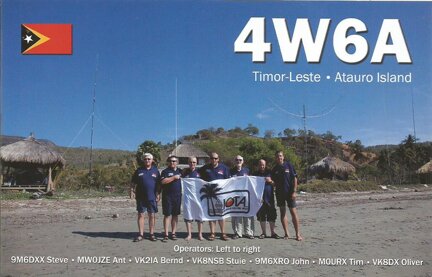
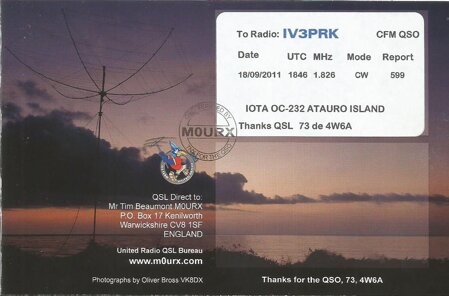
September 2011: 4W6A - Timor Leste by M0URX, 9M6DXX and VK8 Group.
The operations took place between 16 and 26 September 2011, with four stations, but despite the choice of a small island as a free-noise location, good operators and a great effort on 160 meters, it has been quite difficult to work this DXpedition from Europe.
Of the total 41k all-band QSOs, just 508 were made on 160 m. and 112 of them Europeans (45 with zone 14 and 48 with zone 15); only 17 with zone 16 and 2 with zone 20, which are typically favored towards the East… yet another mystery of 160m. propagation!
See my usual analysis and graphs here:
October 2011: T32C - H40KJ - TX7M three DXpeditions… but no joy!
In October 2011, amidst the growing DX activity with rising cycle, there were three DXpeditions in the South Pacific, all targeting rare and challenging countries with difficult high-latitude paths on low bands, yet I couldn’t manage to work any of them! The easiest, or so it seemed, should have been H40KJ, the third DXpedition by Jacek SP5DRH, a dedicated 160m operator, to Temotu Province. The 14,400 km path at 42 degrees was potentially workable after our sunset and before his sunrise.
T32C, a massive DXpedition featuring multiple stations and 38 operators from 11 different nationalities, operated for nearly a month from East Kiribati, one of the most challenging locations for Europe. The path measured 14,625 km at 347 degrees, crossing the demanding polar cap.
Then, in the second part of the month, was TX7M, a Russian-Ukrainian DXpedition to the Marquesas Islands, 15,100 km at 320 degrees. Although it seemed to be the easiest path, it turned out not to be the case.
.png "2025-08-23 (2)")
It had been only two years since October 2009 - the best month I can remember - but 160 meters propagation had significantly worsened. We were in the ascending phase of the 24th cycle, and the solar flux, from a flat value of 70, was now hovering around 150. It's interesting to compare the graph below - with the reported DX activity - with those of two years earlier. The same graph also shows the periods of activity of the three DXpeditions which unfortunately, having left no trace of their signals, only green clouds remained.
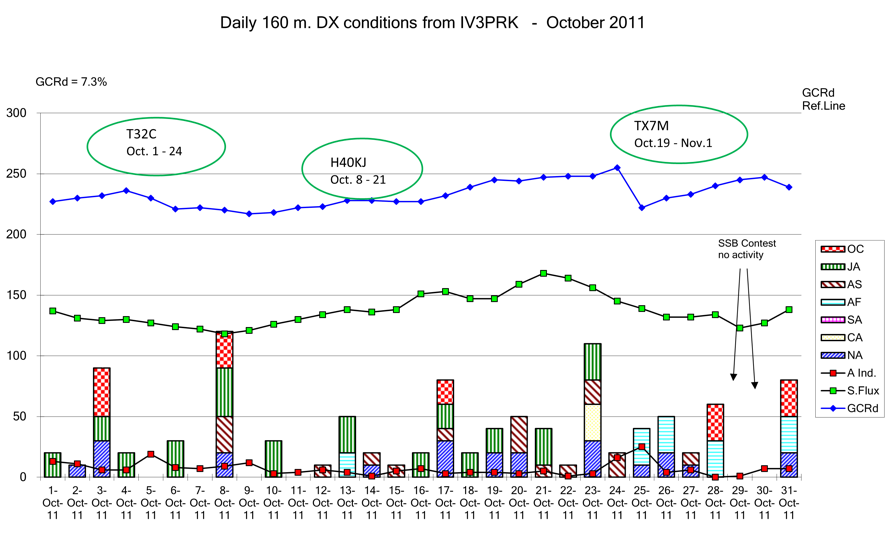
As always, I put in my best effort to work these DXpeditions, moving and phasing the DHDL antennas and laying down temporary on ground Beverages in what seemed to be the optimal directions, but it was all in vain. To reach the Central Pacific, you need really long Beverages, and even then, it’s impossible to predict the effective arrival angle and direction of the DX signal. Sometimes it just comes down to luck - you have to be there - hoping for "your day" and "your spotlight"!
In my case, unfortunately, I also had to contend with the most insidious enemy, he noise level that has inexplicably increased in recent years, even in my quiet countryside location.
Even though I missed them, I conducted my usual analysis on all these DXpeditions to gain a better understanding of propagation and learn, if possible, something more from them.
Jacek shared his H40KJ 160 m log with detailed comments. Over 12 days of operation, he made 575 QSOs on Topband, and after excluding duplicates, he connected with 176 stations in Europe, including 4 in Italy. See here:
The big multinational DXpedition to East Kiribati, T32C, made 216k total QSOs, with 5 thousand on 160 m., but only 126 with Europe, and 14 of them with Italy (all over the long path, and nine of them with I4/IK4) . The PDF file contains also a very interesting letter sent me by John, G3PQA with his observations on propagation and this operations. See here:
Then, the Russian-Ukrainian DXpedition to Marquesas is., TX7M, made 82k all-band QSOs, with 729 on 160 meters. Only 32 of them were with Europe, and 3 with Italy - made from a single well equipped station in the low-lands farmhouse. See here:
January 2012: VP6T - another DXpedition to Pitcairn Island.
This was another DXpedition on Pitcairn is. by F6BEE, F4BKV, FM5CD, VE2TZT and G3TXF. In twelve days of operation (January 21 to February 1) they made 56k all-band QSOs, with 1.212 on 160 meters - 1.033 with NA, but only 79 with Europe. Here is my analysis:
It is interesting to make a comparison with the VP6BR operations in April 2000 by OH2BR - who made also 56k QSOs - but see what a the difference!
February 2012: ZK2C - Niue is. DXpedition by another German group.
This was a DXpedition by DL7JAN and other eight German operators, from 3 to 17 February 2012, with a path to Europe extremely difficult - 17.000 km at 6 degrees, straight across North Pole - and hopeless for most of us under current propagation conditions. They did their best, looking always at the right time for Europe but, in two weeks, they worked only 46 Europeans on 160 m.: four of them in zone 14 and nobody in zone 15. See the details with G3PQA comments here:
March 2013: TX5K - a multi-disciplinary project to Clipperton Island.
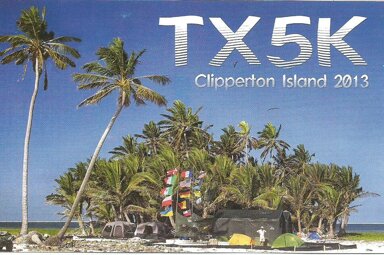
This impressive American-German project involved 24 radio operators and 7 scientists. In one week, from March 2 to 9, with two camps and ten stations, they achieved more than 113,000 QSOs, including 4,000 on 160 meters and 994 of them with Europe. Clipperton, located in the Pacific but in zone 7, offers an easy path—11,400 km at 300 degrees over Mexico—making was accessible for everyone, so no analysis is needed. They were heard here daily on Topband with strong signals, thanks to Dietmar DL3DXX, starting at 03:30 and continuing until 06:00 on March 8, just half an hour after our sunrise!
September 2013: VK9LL - Lord Howe Island by Tomas, VK2CCC.
I have always regretted missing the first Bavarian guys DXpedition to Lord Howe Island twenty years ago—VK9LM in 1993, my last needed country in that area. Now, Tomas VK2CCC was giving me a chance to fill that gap with his upcoming DXpedition. As a lover of 160 meters, he promised his best effort as always. Unfortunately, propagation conditions weren’t as good as they were in November 2009, when I worked him from Vanuatu—YJ0CCC—with only 100 watts. Still, despite being at the solar maximum, conditions weren’t too bad, so I believed it could be done. I decided to bring out the best weapons for the task. In the nearby field, I installed a broadside array of DHDL antennas—90 meters apart—pointed to the desired direction, 65 degrees, and was rewarded! Check out all the details of this installation in the lower section of this page:
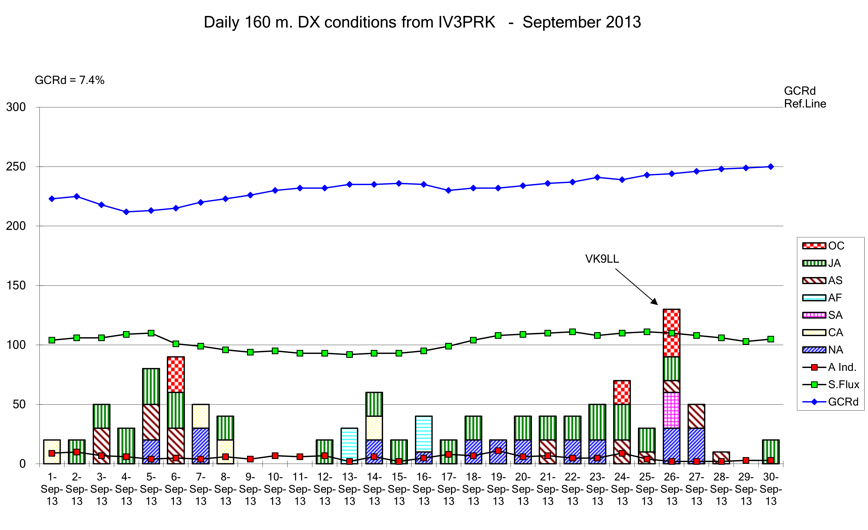
160 m. conditions with Europe have been better than expected for this season, and we must be grateful to Tomas for his dedication and great effort. He has been calling CQ for long periods without any contact, but he never gave up until his sunrise. I guess propagation has been mostly by “ducting mode” and you had just to be lucky waiting for your spotlight.
In six days of Topband activity, he made 359 QSOs: 191 with Europe, 82 with Asia, and only 54 with NA. that was intriguing as evidenced in my analysis:
and more deeper by Carl Luetzelschwab, K9LA, in this very interesting paper:
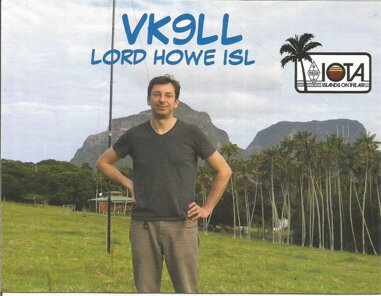
Tomas just wrote a great report “VK9LL story 2013” with a lot of technical information, related links and nice pictures downloadable here. We knew his 160m. dedication and big effort, but we couldn’t know how much experience, preparation and technical skill was behind his DXpeditions. This document is a must to read for serious low-band DXing !
November 2013: K9W - Wake is. Commemorative DXpedition.
The U. S. Air Force allowed a 12-Operator team to enter Wake is., an atoll with an active military base, between 2 and 15 November 2013, for a commemorative DXpedition. The team included known expert low-band operators and thus they should have given a good opportunity to work this rare country on 160 meters also from Europe. The path is a challenge for sure, 27 degrees, with high latitude hops over lossy ice ground, but not impossible like some of those to Central Pacific.

Unfortunately, I had already taken down the double DHDL antennas used for VK9LL chasing and removed all the cables and stuff from outside my fence. Starting October 27, I was in Ecuador overseeing the construction of our new residential house near Quito. When I returned home on November 12, with only two days of operations left, I didn't have time to set up other receiving antennas or even lay down a temporary Beverage. As a result, I only managed to hear K9W briefly but couldn't work it.
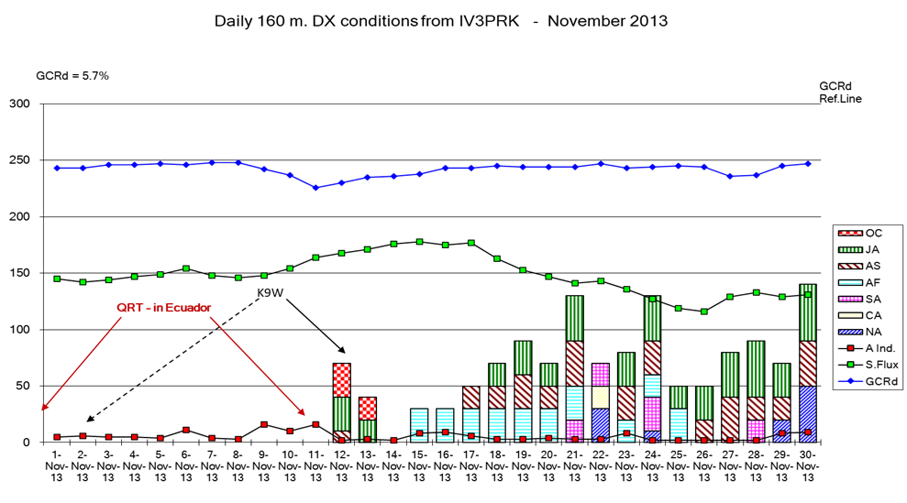
After those short reports on my note-book, I went on Club Log site to investigate and, through statistics and log search, made my usual analysis. In two weeks of operations, the K9W crew made 100k QSOs, 2.100 of them on 160 m., but only 303 with Europe: 223 with European Russia and Ukraine, 63 with zone 15 and 8 with zone 14. Click here for all details:
My final comment regarding this last missed DXpedition aligns perfectly with the page's subtitle when:
“Antennas, listening and… luck were needed!”
I’m afraid this is going to be my last Pacific DXpedition analysis, due to the changes in my life and the changes in DXing, now much easier for everybody thanks to internet and computers. But, worst of all, is the shame of getting on the log by means of cheating and remote SDR contacts. Unfortunately, this has rendered grid locators, which are fundamental to the analysis, unreliable.