by Pierluigi Mansutti IV3PRK - all rights reserved
IV3PRK Pierluigi “Luis” Mansutti
160 Meters: DXing on the Edge
Propagation and DXing on 160 meters.
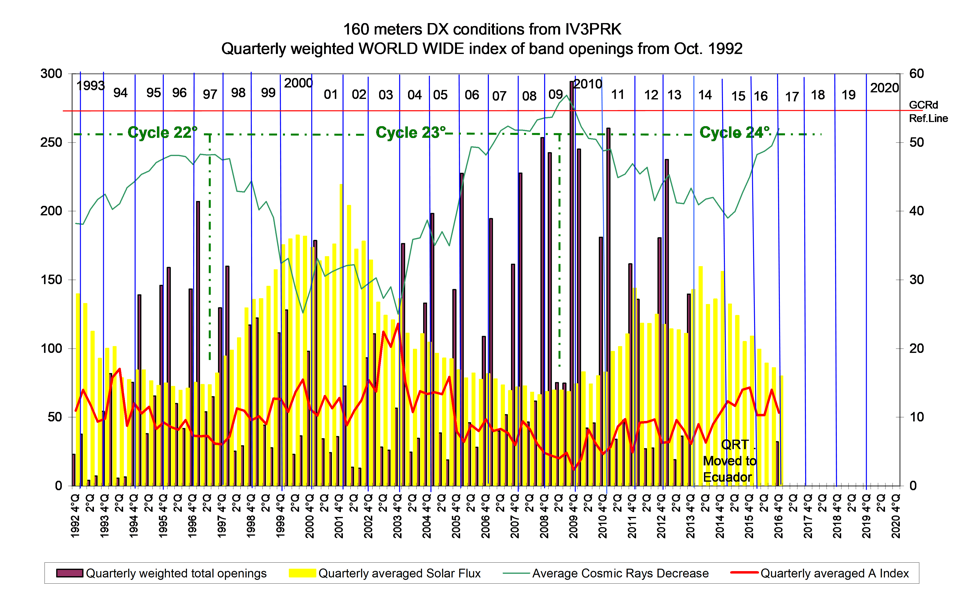
Propagation studies have always been my main interest. Since 1993, I have kept regular records of 160 m daily DX activity across all continents using several Excel spreadsheets, trying to correlate it with solar and geomagnetic activity. However, the mystery of 160 m propagation remains unsolved! Unfortunately, I had to suspend my records from January 2014 to 2016 due to my move to Ecuador. In 2017, I attempted to resume them but eventually gave up, as it seemed pointless to continue with graphs truncated halfway through solar cycle 24. As an example, here is a summary graph showing quarterly DX openings monitored over twenty years of 160 m activity, compared to the average Solar Flux, A Index, and Cosmic Ray Decrease during the same periods.
Some years ago, I hold a series of lectures on propagation for the local ARI Section. They are all downloadable in the original Italian language, in PDF format, from this dedicated page:
Anyway, I translated in English the chapter n. 4, related to 160 meters, and expanded in the following three files:
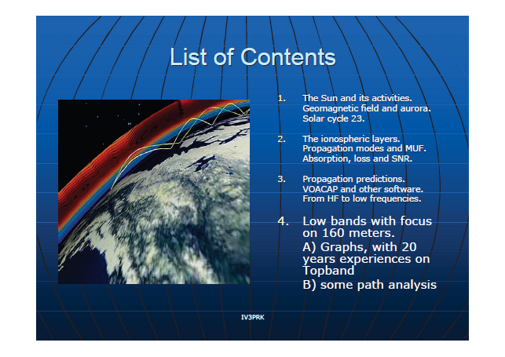
Nr. 1 -Starting with the K9LA lecture “DXing on 160m at Solar Maximum” from the NW DX Convention in Seattle 2004, I incorporated numerous graphs illustrating DX conditions across all continents over the years, along with final comments on the best season for 160m DXing. Additionally, I included the use of the Gray-line and several graphs showing statistical daily openings throughout the months toward all continents, resulting in a comprehensive 43-page document.
Nr. 2 - This is an in-depth analysis of the path between Italy and New Zealand in search of an explanation for an impressive opening that occurred on March 5, 2004, with very strong signals (18.09z - ZL1MH 599/599; 18.22z - ZL3IX 589/569). The document includes comments and numerous screenshots from the programs used: PropLab-Pro by Solar Terrestrial Dispatch, which illustrates the ducting conditions on the path, and another 160m specialized program, Prop7R, created by Roger Graves VE7VV in DOS with the assistance of Prof. R. Brown NM7M, though it was never marketed. Using the VE7VV program, I also obtained results analyzing the KH6 path, but this proved more complex due to potential skewing around the auroral oval or across South America (details in file no. 3) - 27 pages.
The 160-meters path to Hawaii.
Nr. 3 - Building on what was previously mentioned, this document, made up of 38 screenshots,
is devoted to the 160 m path between Italy and Hawaii. It includes a detailed analysis of my first QSO with Jack, KH6CC, on January 7, 1994. I worked him at 05:15 z while listening to the West direction, amidst about a dozen QSOs with stations in AL, FL, LA, TX, and El Salvador.
At the end, as an appendix to the document, I added an analysis of another QSO between KH6CC and my friend Marco, IK2DFZ, in Milan. This took place in January 2005 at 16:40z, after our sunset, and followed a very different route, likely through or—more probably—around the polar cap.
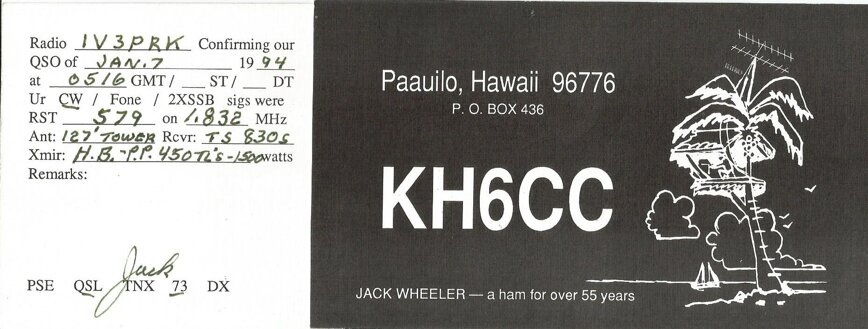
In the hours after sunset in Europe and before sunrise in Oceania, the likely path is clearly towards the north or northeast. However, in the morning, things become much more complex. Taking my first KH6CC QSO as an example, I used the two propagation programs mentioned earlier, along with DX Atlas, to analyze four hypotheses for this specific contact, all based on a sunspot number of 30 and an Ap index of 5. After reviewing nearly thirty screenshots, the conclusions are as follows:
Case 1 - 350° over the North Pole: A short path of 12,500 km over the polar cap is possible, as expected, but only under low solar activity during low solar cycles. This requires no aurora activity and typically occurs after sunset in Europe, not at this time of day.
Case 2 - 300° skewed path over southern USA: This proposed path over W4 does not seem to work, as the rays skew in opposite directions. A more likely scenario involves a path around the aurora belt, meeting the short-path ray arriving from KH6.
Case 3 - 270° skewed path over northern South America: This seems to be the most viable option, following gradients of low ionization with proper skewing on both sides. Favorable ducting on the Pacific side reduces absorption along the 18,000 km path.
Case 4 - 220° skewed path over southern South America, near the Gray Line: Running parallel to the terminator but offset by 1,600 km (or 1.5 hours), this nearly 25,000 km path crosses steep gradients in highly ionized areas of the southern hemisphere, making it almost impossible.
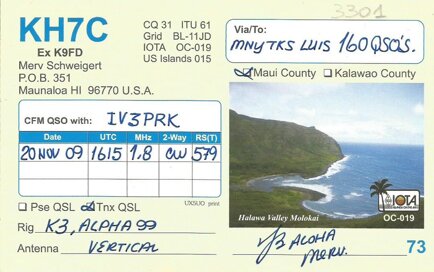
As said, the above hypotheses refer to the typical hours, in our morning before sunrise. But during a low solar cycle and no aurora, the path to the Central Pacific is also good, or even better, around sunset in Europe. The months of October and November 2009 were incredible - the best 160-meter season of my life - give a look at the graph on top of this page. I’ll always remember working so many new ones, including Fiji Islands, Conway Reef, New Caledonia, Chesterfield Islands, Austral Islands, Vanuatu, as well as Alaska and Hawaii, both in the morning and evening. This is one of my QSOs with Merv, ex-K9FD, half an hour after my sunset.
At the time of writing this document, back in May 2006, I could perform an analysis of a similar QSO between KH6CC and IK2DFZ on January 11, 2005, at 16:41z - 43 minutes after sunset in Milan and 27 minutes before sunrise in Honolulu. At that time, we weren’t quite at solar minimum (Solar Flux 94 and A index 11). As usual, I utilized PropLab-Pro, Prop7R, and DX Atlas for the analysis.
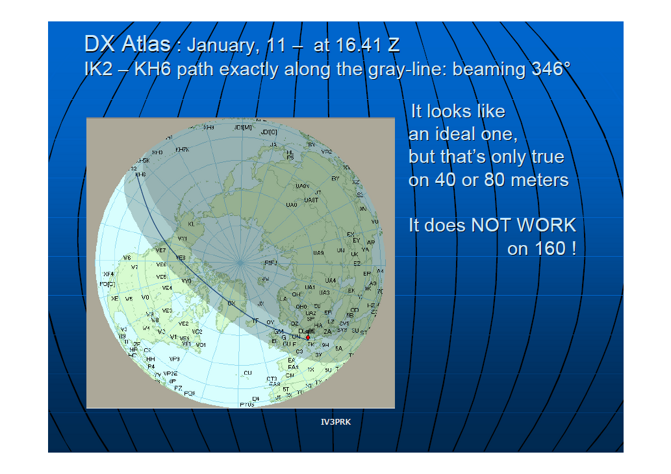
In this case, there weren’t four hypotheses to evaluate. The only choice was to head north, moving from the Gray-line to a skewed route along the eastern edge of the polar cap. During January at 16:40 z, the Terminator is perfectly positioned between northern Italy and Hawaii, making it ideal for 40 and 80 meters. However, on 160 meters, it doesn’t work due to excessive ionization along the path, as evident in the accompanying two maps of the critical frequencies F0F2.
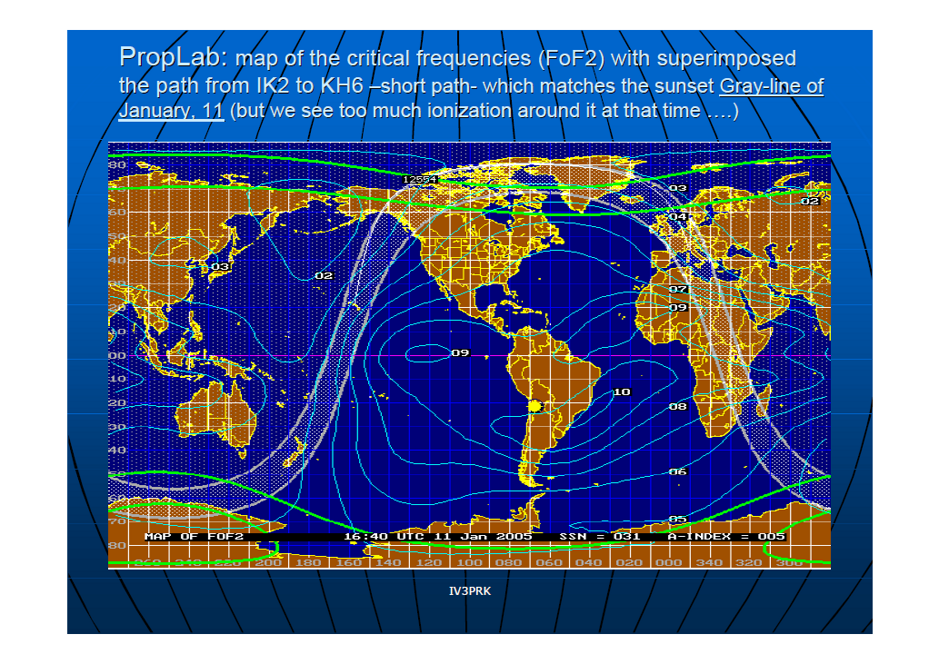
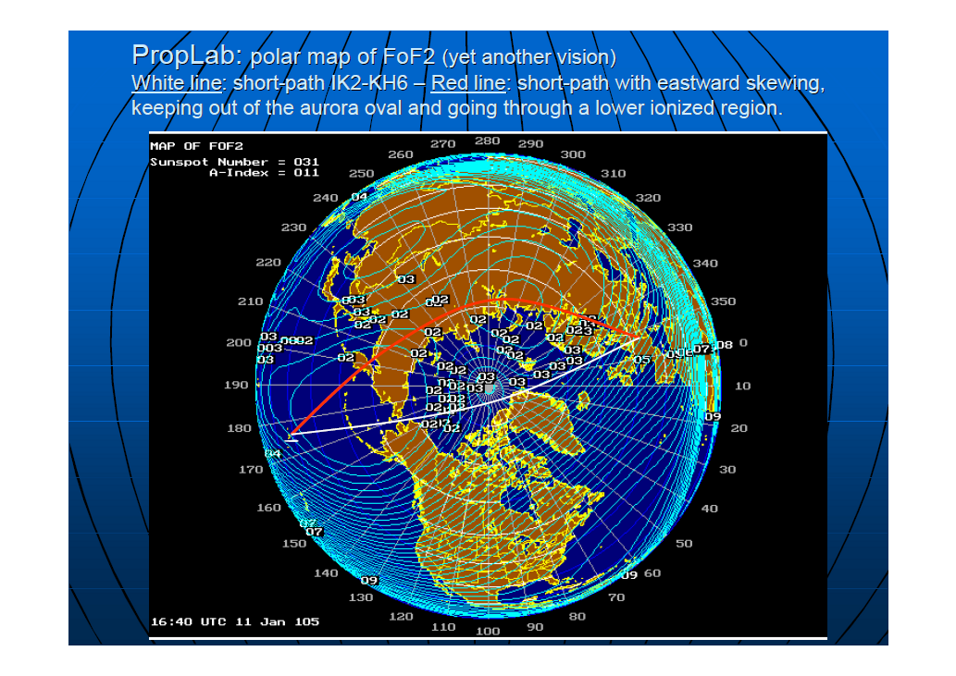
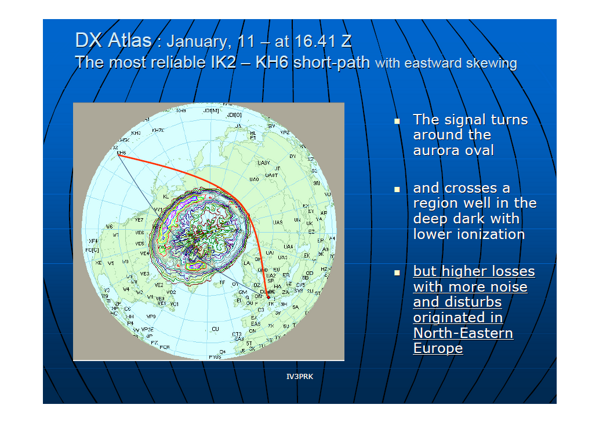
Returning to DX Atlas for conclusions, the 1.8 MHz signal cannot penetrate the aurora oval and gets skewed to the eastern side over Siberia, crossing a dark region of favorable low ionization, but with multiple ground reflections over ice or snow, resulting in significant signal loss.
Additionally, pay attention to the direction of the received signal, which can deviate 30 to 45 degrees from the anticipated beam, depending on the width of the aurora oval. Sometimes, a very long Beverage antenna might not be the best option!
Click here for all the screenshots of this analysis:
At the Contest University Italy 2011 with Jeff, K1ZM.
The last graphics featuring my statistical data and comments were updated and included in a major presentation, delivered in PowerPoint slides, during March 2011 at the Contest University Italy in Montichiari. It was based on a lecture given by Carl Luetzelschwab, K9LA, at the RSGB convention in 2010, translated into Italian, and modified with his authorization to include additional pages of my own. Later, all 55 pages were translated back into English and made available for download here:
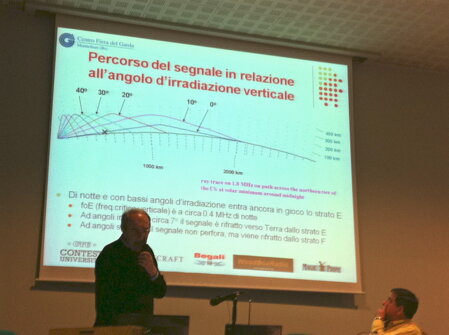
The most notable guest at the CTU convention was my friend Jeff Briggs, K1ZM, author of the book “DXing on the Edge,” from which the payoff of this website was inspired. After his lecture “Contesting from VY2ZM Paradise at -35C!” he enhanced my presentation with his personal comments, as depicted in this picture.

I highly recommend reading the above document. It thoroughly explores all the features and highlights of 160-meter DXing, covering everything from the basics to ducting, NM7M galactic rays theory, skewed paths, propagation along the Gray-line, and even long-path. It includes insightful comments from notable figures like W4DR, W4ZV, K1ZM, VE7DXR, ZL3IX, and more.
I could suggest plenty of readings, starting with the works of Prof. Robert Brown, NM7M, including “Long-Path Propagation” revisited in 2000 and “The Big Gun's Guide to Low-Band Propagation” published in 2002. However, it's much easier to find all the 160-meter resources on Carl's dedicated page.
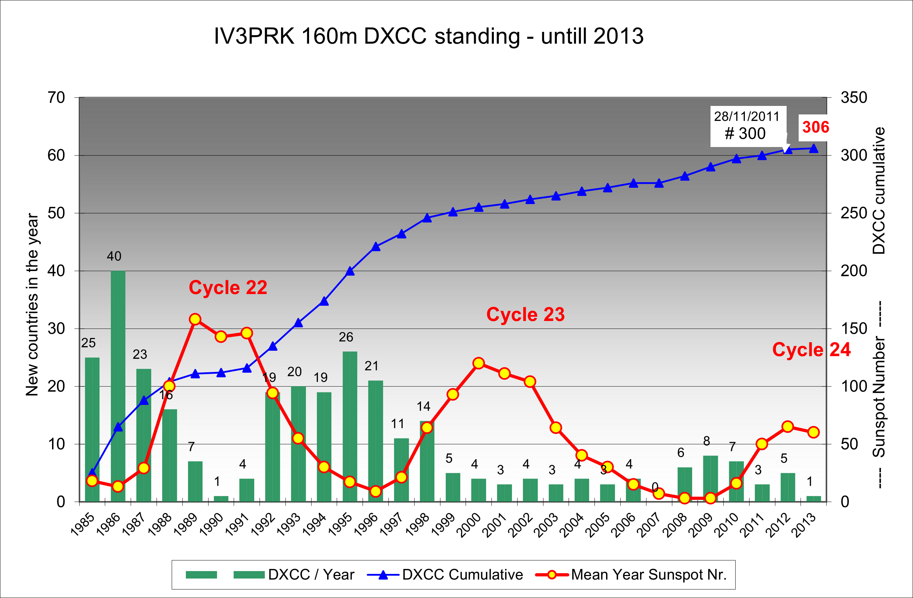
As mentioned earlier, my regular statistical graphs on 160-meter propagation ended in December 2013 when I moved to Ecuador. That same year also marked the conclusion of my serious DXCC hunting at #306. Following my HC1PF operations, I casually added two more on CW. But DXing on 160 meters has changed significantly, with most activity now on FT8, which makes everything much easier. However, the widespread use of remote SDRs and generalized cheating has become a blight on the band, rendering DXCC competition meaningless.
For the same reason, it's currently impossible to continue analyzing Pacific DXpeditions - discussed on the next page - based on the grid locator of the logged stations (as found on QRZ.com): how many are transmitting and receiving from their home location, and how many are using remote SDRs connected via the internet from a different continent? That said, I haven't given up yet!
Propagation study remains my main interest, and I went back to a beautiful two-month article published in CQ Magazine, March and April 1998, by Cary Oler (Solar Terrestrial Dispatch) and T. Cohen, N4XX:
As noted on the homepage, I've devoted two pages on this site to "the 160m propagation mystery," covering new info, calculation path losses and ducting, inspired by Carl, K9LA, along with his formulas. Click here:
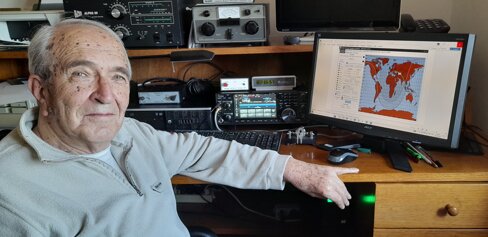
The journey goes on—I’ve just acquired the latest version of Proplaqb-Pro by Solar Terrestrial Dispatch, the world’s most advanced radio propagation ray-tracing system, to deepen my analysis. Stay tuned, as I’ll be sharing something new on this topic soon!